Radio Signal Detected from Alien Planet for First Time: Inside Beta Pictoris b's Colossal Magnetic Field
Astronomers utilizing South Africa's MeerKAT radio telescope array have confirmed the first-ever direct radio emissions isolated to an exoplanet. Traced to gas giant Beta Pictoris b, located 63 light-years away, the signals reveal a colossal planetary magnetic field at least 200 times stronger than Jupiter's—marking a historic leap in the search for magnetospheres that shield habitable worlds.

1.A Cosmic Milestone: Localizing Radio Waves to a Distant World
In an astronomical breakthrough that redefines our understanding of extra-solar worlds, an international team of astrophysicists has directly detected radio wave emissions originating from a planet outside our solar system. The discovery, reported in a comprehensive investigation led by researchers at the Center for Astrophysics | Harvard & Smithsonian, traces repeating radio bursts directly to Beta Pictoris b—a massive gas giant located approximately 63 light-years from Earth in the southern constellation Pictor.
While astronomers have theorized for decades that planets orbiting distant stars must generate radio emissions similar to Jupiter and Saturn, previous observational attempts yielded ambiguous data. Past signals were either too faint to distinguish from cosmic background noise or could not be cleanly separated from the violent magnetic tantrums of their host stars.
"What is unique for this study is that they localise the emission to the planet itself, separate from the star," noted Dr. Joseph Callingham, an associate professor at the Anton Pannekoek Institute for Astronomy at the University of Amsterdam, who was not involved in the research. By isolating the planetary emission, astronomers have crossed a historic threshold: measuring the intrinsic magnetism of an exoplanet directly.
2.Not Intelligent Life: The Physics of Auroral Cyclotron Radiation
Whenever "radio signals from deep space" capture global headlines, public imagination naturally jumps to the search for extraterrestrial intelligence (SETI). However, the researchers emphasize that this signal is not a transmission from an alien civilization, but rather the unmistakable signature of fundamental cosmic electromagnetism.
"I know radio signals are associated with searches for extraterrestrial intelligence," explained Dr. Edo Berger, professor of astronomy at Harvard University and senior co-author of the study. "But this is something very different. In order to see radio waves that extend all the way to the frequencies that we observed, you need an incredibly strong magnetic field."
The phenomenon is known as Auroral Cyclotron Maser Emission (ECME). When high-energy charged particles—such as electrons accelerated by stellar winds or trapped in a planet's radiation belts—funnel along invisible magnetic field lines toward a planet's polar regions, they spiral violently around magnetic flux tubes. As they collide with the upper atmosphere, they produce brilliant, shimmering auroral displays—analogous to Earth's Northern Lights—while simultaneously amplifying and beaming coherent, polarized radio waves across interstellar space.
3.Colossal Magnetism: 200 Times Stronger Than Jupiter
The critical parameter decoded from the MeerKAT radio frequencies is the sheer intensity of the planet's magnetic shield. On Earth, our liquid-iron outer core generates a surface magnetic field measuring roughly 0.5 Gauss—sufficient to deflect solar radiation and protect our biosphere. In our solar system, Jupiter reigns supreme, boasting a field of up to 14 Gauss that powers a magnetosphere stretching 3 million kilometers toward the Sun, making it the largest single structure in our planetary system.
Beta Pictoris b obliterates both records. According to lead author Kevin Ortiz Ceballos, a doctoral researcher at the Center for Astrophysics | Harvard & Smithsonian, the frequencies observed require an extraordinary planetary magnetic field strength of at least 1,250 Gauss:
• Over 200 times stronger than Jupiter's formidable magnetic field. • More than 2,500 times more powerful than Earth's geomagnetic envelope. • Comparable in magnetic flux to cool brown dwarfs—celestial "failed stars" that are up to 80 times the mass of Jupiter.
"This was really unexpected for us," Berger recalled. "We were doing the survey as a bit of a fishing expedition, knowing that we would only detect sources if the magnetic field was incredibly strong. It went completely against the perceived wisdom in the field, which assumed exoplanetary magnetic fields would look roughly like Jupiter's and emit at far lower frequencies."
4.The MeerKAT Radio Telescope: Pushing the Limits of Spatial Resolution
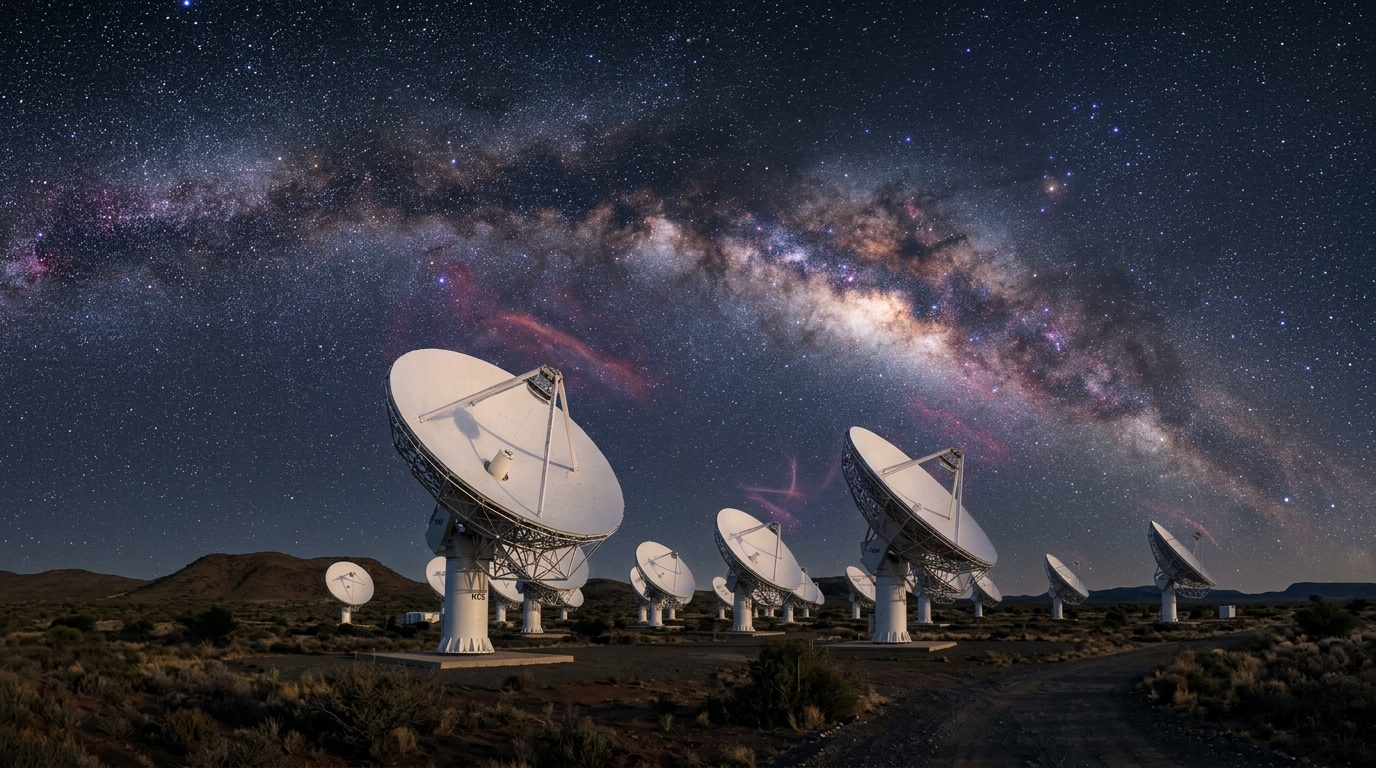
Pinpointing a planet 63 light-years away while it orbits close to a brilliant stellar furnace required one of the most sensitive radio observatories on Earth: the MeerKAT array, situated in the arid Karoo region of South Africa. Comprising 64 high-gain dish antennas spanning 8 kilometers, MeerKAT provides the extreme baseline resolution needed to isolate faint celestial signals.
Beta Pictoris b was originally discovered in 2008 by the European Southern Observatory (ESO) via direct infrared imaging. Measuring nearly twice Jupiter's diameter and packing roughly 12 times Jupiter's mass, the planet orbits its host star at a distance of about 9 to 10 Astronomical Units (AU)—roughly the distance from our Sun to Saturn.
During dedicated observation campaigns between 2025 and mid-2026, Ceballos and the MeerKAT team repeatedly tracked the system:
1. Temporal Repeatability: The radio bursts were detected across multiple epochs and at varied observing frequencies, ruling out instrumental glitches or one-off transient bursts. 2. Positional Disambiguation: By precisely calculating the orbital astrometry of Beta Pictoris b relative to its host star, the researchers proved the emission tracks the planet's orbital motion rather than stellar flare activity from the star. 3. Stellar Quietude: Fortunately, the host star Beta Pictoris is an A-type star that is magnetically relatively quiet in the radio spectrum, allowing the planet's brilliant auroral broadcast to shine through without being blinded by stellar radio noise.
5.Internal Dynamo Engines: Youthful Heat vs. Volcanic Exomoon Hypothesis
What drives a planetary magnetic field of such staggering power? Astronomers are evaluating two primary geophysical hypotheses:
1. The Youthful Super-Dynamo Hypothesis: The Beta Pictoris system is astronomically newborn—only 20 to 25 million years old, compared to our solar system's mature 4.5 billion years. Beta Pictoris b is still hot from its initial gravitational collapse, retaining internal temperatures exceeding 1,500 Kelvin. This immense primordial thermal reservoir fuels violent convective churning inside its metallic liquid hydrogen mantle, driving a rapid internal dynamo that supercharges magnetic field lines far beyond older, cooler gas giants.
2. The Volcanic "Super-Io" Exomoon Hypothesis: In our own solar system, Jupiter's auroras are not fueled primarily by the solar wind, but by its volcanic moon Io, which continuously spews one ton of sulfur dioxide gas per second into Jupiter's magnetosphere, creating a dense plasma torus that triggers intense auroral radio masers. A massive, volcanically hyperactive exomoon orbiting Beta Pictoris b could be injecting colossal amounts of ionized gas into the planet's magnetic envelope, creating the intense radio emission detected by MeerKAT.
6.Implications for Astrobiology: The Shield That Makes Worlds Livable
While Beta Pictoris b itself is a scalding gas giant incapable of harboring life as we know it, the successful detection of an exoplanetary magnetic field represents a monumental leap for astrobiology and the broader search for life in the universe.
Planetary magnetic fields serve as indispensable cosmic deflector shields. Without a robust magnetosphere, energetic stellar flares, coronal mass ejections, and stellar winds strip away a planet's atmosphere over cosmic timescales—as famously occurred on Mars when its internal dynamo died billions of years ago.
"Habitability is probably one of the main reasons we're interested in magnetospheres," emphasized Dr. Yvette Cendes, an astronomer at the University of Oregon and study co-author. "If we can detect magnetic fields on giant planets, we are laying the foundational methodology to eventually detect them on smaller, rocky, Earth-sized worlds."
Because rocky terrestrial planets possess much weaker magnetic fields whose low-frequency radio emissions are blocked by Earth's ionosphere, future space-based radio interferometers—or radio telescope arrays situated on the radio-quiet far side of the Moon under NASA's Artemis program—will be required to scout for magnetic shields around rocky worlds in habitable zones.
Key Facts & Comparison
| Parameter | Earth | Jupiter | Beta Pictoris b (Exoplanet) |
|---|---|---|---|
| Distance from Earth | 0 Light-Years (Home) | 43 Light-Minutes (~4.2 AU) | 63 Light-Years (~3.98 Million AU) |
| Planetary Mass | 1.0 Earth Mass (M_E) | 317.8 M_E (1.0 Jupiter Mass) | ~3,814 M_E (~12.0 Jupiter Masses) |
| Estimated Radius | 6,371 km (1.0 R_E) | 69,911 km (1.0 R_J) | ~115,000 km (~1.65 R_J) |
| System Age | 4.54 Billion Years | 4.54 Billion Years | 23 to 25 Million Years (Very Young) |
| Surface Magnetic Field | ~0.5 Gauss | 4.2 to 14.0 Gauss | ≥ 1,250 Gauss (Extraordinary) |
| Relative Field Strength | 1x (Baseline) | ~28x Earth | ≥ 2,500x Earth (≥ 200x Jupiter) |
| Primary Radio Mechanism | Auroral Kilometric Radiation (AKR) | Decametric Auroral Masers (DAM) | Auroral Cyclotron Maser Emission (ECME) |
| Key Observing Instrument | Geomagnetic Ground Arrays | Voyager, Galileo, Juno Orbiters | MeerKAT 64-Dish Array (South Africa) |
Frequently Asked Questions (FAQ)
Q1: Does this radio signal mean astronomers found alien intelligence?
No. The signal is entirely natural. It is produced by Auroral Cyclotron Maser Emission (ECME)—a physical process where charged electrons spiral along strong planetary magnetic fields into the polar atmosphere, generating coherent radio bursts alongside brilliant auroral lights.
Q2: How did scientists prove the radio signal came from the planet and not its host star?
The researchers utilized the high-resolution MeerKAT radio array in South Africa to track the system across multiple frequencies and time periods. The spatial coordinates of the radio bursts tracked the orbital trajectory of Beta Pictoris b precisely, while the host star remained radio-quiet.
Q3: Why is Beta Pictoris b's magnetic field 200 times stronger than Jupiter's?
Astronomers believe its young age (only ~23 million years old) means the planet retains immense primordial internal heat, driving rapid, vigorous convection in its metallic hydrogen core. Alternatively, an active volcanic exomoon could be supplying ionized plasma to supercharge the magnetic field.
Q4: Can humans travel to Beta Pictoris b?
Not with current technology. At 63 light-years away (approximately 370 trillion miles), a journey would take over a million years using conventional chemical rocketry. However, robotic probes and next-generation space telescopes can analyze its atmosphere remotely.
Q5: Why are planetary magnetic fields important for finding life elsewhere?
Magnetic fields shield atmospheres from being stripped away by ionizing stellar winds and cosmic radiation. Detecting magnetic fields around exoplanets proves that planets outside our solar system can maintain the natural shields necessary to support liquid water and stable biospheres.
Editorial Standards & Fact-Checking Transparency
This report adheres to Daily Science News' rigorous academic guidelines. All claims are verified against primary scientific literature from institutions including NASA, ESA, CERN, and peer-reviewed journals. Supervised by Dulaksha Sandeepa. Questions or corrections? Contact contact@sciencenewshub.click.