Bizarre Deep Sea Creatures Caught Hitchhiking on Giant Sea Spiders in the Deep Blue Sea
Thousands of meters beneath the surface, where sunlight never penetrates the crushing depths of the deep blue sea, life adapts in ways that continuously defy conventional biology. While most ocean researchers focus on bioluminescent cephalopods or pelagic deep sea fish to understand the abyss, marine biologists exploring the southeastern Pacific Ocean have documented an unexpected ecological partnership: tiny, shrimp-like deep sea creatures deliberately hitchhiking on the bodies of colossal giant sea spiders.
1.An Extraordinary Discovery in the Abyssal Depths
Thousands of meters beneath the surface, where sunlight never penetrates the crushing depths of the deep blue sea, life adapts in ways that continuously defy conventional biology. While most ocean researchers focus on bioluminescent cephalopods or pelagic deep sea fish to understand the abyss, marine biologists exploring the southeastern Pacific Ocean have documented an unexpected ecological partnership: tiny, shrimp-like deep sea creatures deliberately hitchhiking on the bodies of colossal giant sea spiders.
The groundbreaking observations, published in the peer-reviewed scientific journal Ecology, provide the first direct in situ photographic and video proof of an intricate symbiotic rideshare that could explain how slow-moving benthic invertebrates traverse vast distances across the ocean floor.
The sightings occurred during an exploratory research voyage aboard the research vessel Falkor (too), operated by the Schmidt Ocean Institute. Marine biologists led by Dr. Jorge Pérez-Schultheiss from the National Museum of Natural History of Chile deployed the high-resolution remotely operated vehicle (ROV) SuBastian to survey steep submarine canyons along the Chilean Margin—a dynamic geological boundary where three tectonic plates converge.
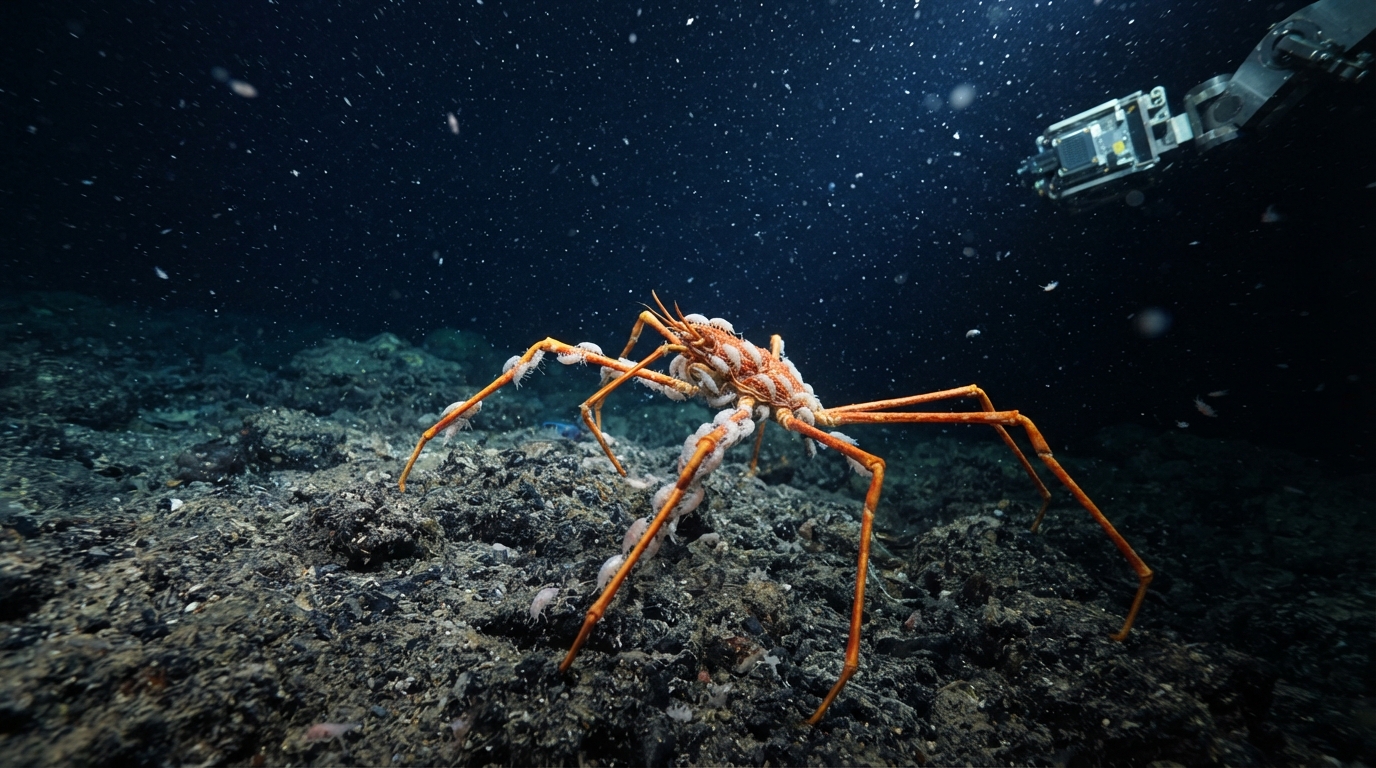
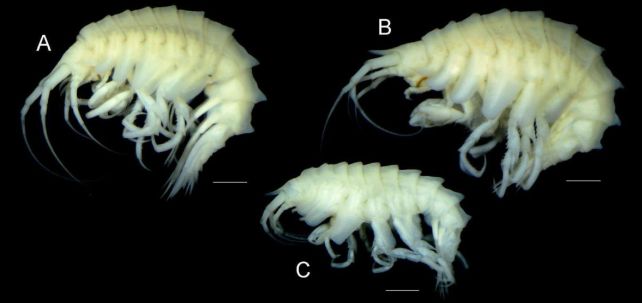
Descending into the midnight zone at an astonishing depth of 3,155 meters (10,351 feet), the submersible's robotic floodlights illuminated a massive giant sea spider (Colossendeis colossea) stalking slowly over basalt debris. While deep sea fish like rattails and grenadiers swam through the dark water column above, the cameras captured an unprecedented sight on the sea floor: three small, pale amphipods (Mesopleustes abyssorum) were anchored tightly to the sea spider's appendages. Two larger individuals were clamped to the host's sensory appendages and reproductive ovigers, while a smaller female rode on one of its rear walking legs.
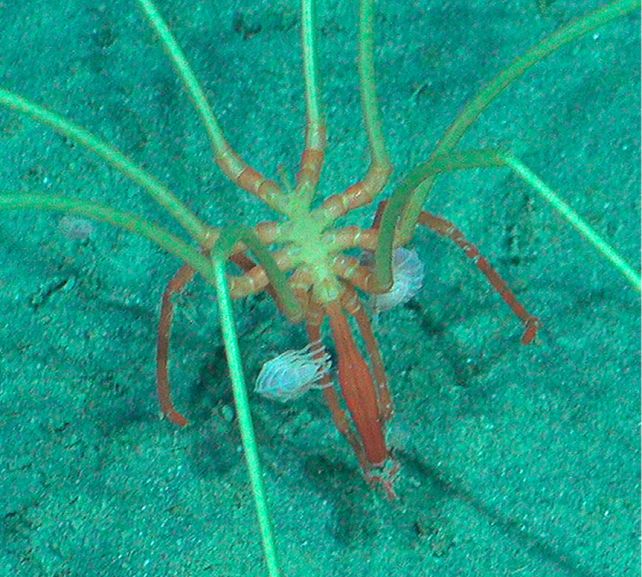
Just four days later and approximately 225 kilometers (140 miles) away, at a depth of 2,698 meters (8,852 feet), ROV SuBastian encountered a second giant sea spider. Attached to its spindly limbs in identical fashion was another pair of Mesopleustes abyssorum amphipods, locked in place with curved, claw-like appendages.
2.Why Do These Deep Sea Creatures Hitchhike?
In marine ecology, when one organism uses another purely for transportation without causing immediate parasitic harm, the relationship is termed phoresis. While scientists frequently document remoras hitching rides on sharks or large pelagic deep sea fish, observing mobile benthic arthropods using giant pycnogonids as deep-sea transit is exceptionally rare.
Researchers point to three primary evolutionary drivers facilitating this rideshare behavior across the deep blue sea:
1. Long-Distance Dispersal for Weak Swimmers Mesopleustes abyssorum presents an evolutionary paradox. Although specimens have been recorded across the Pacific, Atlantic, Indian, and Southern oceans, they lack a planktonic larval drift stage and are notoriously poor free-swimmers. Giant sea spiders, however, are adept long-range travelers. Beyond walking across rugged ocean sediment, they can spread their massive leg spans to catch benthic thermal currents, effectively drifting across vast underwater canyons. By anchoring themselves to these giant arthropods, the amphipods enjoy long-distance travel without expending precious metabolic energy.
2. Mobile Mating Encounters in the Void Finding a mate in an empty, pitch-black ecosystem spanning millions of square kilometers is one of the greatest survival hurdles for small deep sea creatures. In both sightings documented by ROV SuBastian, the paired hitchhikers consisted of adult males and females, with one female actively brooding egg clutches. A roaming giant sea spider serves as an elevated, mobile congregation beacon where solitary crustaceans can cross paths.
3. Scavenging and Benthic Foraging In the low-nutrient abyssal zone, food consists mainly of "marine snow"—organic debris drifting down from surface waters—or scraps left behind by predatory invertebrates and scavenging deep sea fish. Riding high on a sea spider elevates the amphipods above the muddy seafloor, placing them directly into rich horizontal nutrient currents while offering camouflage and distance from benthic predators.
3.A Century-Old Deep Ocean Mystery Confirmed
Interestingly, scientific literature hinted at this deep-sea alliance nearly a century ago. In 1927, an archival zoological note documented a single amphipod clinging to a preserved sea spider in a trawl net. However, because dredging nets violently churn marine life together, scientists long assumed the pairing was an artificial accident of collection.
The high-definition footage gathered by ROV SuBastian finally proves that these bizarre deep sea creatures actively seek out and utilize giant sea spiders in undisturbed habitats. Even after the robotic arms scooped both organisms into pressurized sampling bio-boxes, the crustaceans refused to release their grip.
As marine robotics descend further into the uncharted trenches of the deep blue sea, discoveries of such complex behaviors remind researchers that life on the ocean floor thrives through extraordinary, cooperative strategies.
4.Extreme Physiological Adaptations to Abyssal Hydrostatic Pressure
Surviving at depths exceeding 3,000 meters requires extreme biological resilience. At this depth, the ambient hydrostatic pressure exceeds 300 atmospheres—over 4,400 pounds per square inch—capable of collapsing standard gas-filled organs and distorting cellular protein structures.
Both Colossendeis colossea and Mesopleustes abyssorum have evolved specialized biochemical adaptations to withstand these intense abyssal conditions:
• Flexible Chitinous Exoskeletons: Rather than building heavily calcified shells that require large amounts of calcium carbonate (which dissolves rapidly at extreme depths due to high acidity and the carbonate compensation depth), both species utilize thin, flexible protein-chitin matrices that deform without shattering.
• Piezolyte Cellular Protection: Deep sea creatures accumulate high concentrations of piezolytes—organic osmolytes such as trimethylamine N-oxide (TMAO)—which stabilize intracellular water networks and prevent water molecules from being forced into folded metabolic enzymes.
• High-Efficiency Circulatory Systems: Because sea spiders lack respiratory lungs or gills, gas exchange takes place directly through their long, porous walking legs, driven by peristaltic contractions of their gut walls. For the tiny amphipod hitchhikers, clinging to these slow-moving appendages exposes them to constant, oxygen-rich boundary currents without the need for active swimming.
Ecosystem Breakdown: Host vs. Passenger
Key biological, anatomical, and ecological comparisons between the pycnogonid host and the hitchhiking amphipod.
| Biological Feature | The Host: Colossendeis colossea | The Passenger: Mesopleustes abyssorum |
|---|---|---|
| Taxonomy | Pycnogonid (Giant Sea Spider) | Malacostracan (Amphipod Crustacean) |
| Common Classification | Marine Arthropod | Shrimplike Deep Sea Creature |
| Size / Span | Up to 50–70 cm leg span | 1–3 cm body length |
| Locomotion Style | Benthic crawling & current drifting | Poor swimming, sediment crawling |
| Observed Depth Range | 2,000 to 4,000+ meters | 690 to 3,500+ meters |
| Ecological Niche | Benthic predator & scavenger | Commensal hitchhiker & filter feeder |
| Attachment Method | Long chitinous limbs & ovigers | Curved, specialized dactyl claws |
Frequently Asked Questions (FAQ)
Q1: Are giant sea spiders related to land spiders?
No. Giant sea spiders belong to the class Pycnogonida. While they are marine arthropods, they are only distant evolutionary cousins of terrestrial arachnids and spend their entire lifecycles on the ocean floor.
Q2: Do deep sea fish prey on these amphipods?
Yes. Bentho-pelagic deep sea fish, such as rattails, cusk-eels, and grenadiers, opportunistically feed on small crustaceans. Hitchhiking high off the seafloor on the spiny limbs of a large sea spider provides distance and camouflage against ground-dwelling predators.
Q3: Does the sea spider get harmed by the hitchhikers?
Current scientific observations indicate no tissue damage or parasitic harm to the sea spider. The relationship appears to be commensal (phoresis), where the amphipod benefits from transport and feeding without negatively impacting the host.
Q4: What depth was this symbiotic behavior discovered at?
The interactions were documented at astonishing depths between 2,698 meters (8,852 feet) and 3,155 meters (10,351 feet) along the steep submarine canyons of the Chilean Margin in the southeastern Pacific Ocean.
Editorial Standards & Fact-Checking Transparency
This report adheres to Daily Science News' rigorous academic guidelines. All claims are verified against primary scientific literature from institutions including NASA, ESA, CERN, and peer-reviewed journals. Supervised by Dulaksha Sandeepa. Questions or corrections? Contact contact@sciencenewshub.click.