Dinosaur-Killing Asteroid Impact Released Heat 17 Times Greater Than Maximum Human Tolerance, New Study Reveals
A new study reveals the 66-million-year-old Chicxulub asteroid impact generated heat 17 times beyond human tolerance limits, instantly killing open-air dinosaurs within hours and triggering massive global wildfires — overturning the previous 'impact winter' theory of dinosaur extinction.
1.New Details About the Dinosaur-Killing Asteroid Strike
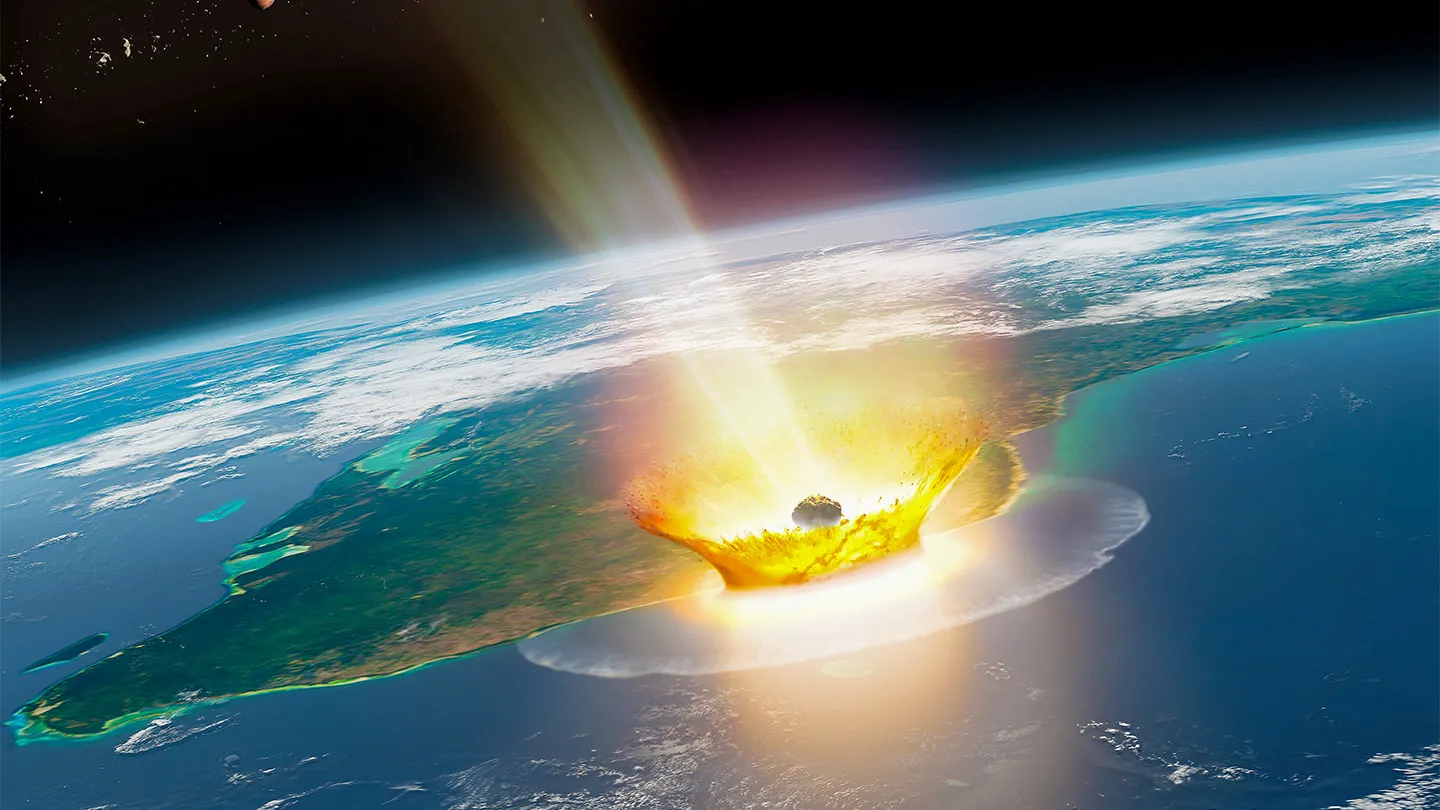
New details have been revealed about the giant asteroid that crashed into Earth 66 million years ago, causing the mass extinction of the dinosaurs. The previous dominant scientific view was that dinosaurs died of starvation due to a prolonged 'impact winter' that followed the asteroid impact — when debris blocked sunlight for years, collapsing food chains. However, a groundbreaking new study shows that the extreme heat and flames generated when the asteroid struck Earth may have caused even thick-skinned dinosaurs to burn to death within hours. Scientists point out that this thermal radiation was approximately 17 times greater than the maximum thermal limit a human body can endure.
2.The Mechanics of the Chicxulub Impact
The Chicxulub asteroid, approximately 10 kilometers wide, vaporized an enormous amount of rock when it crashed into Mexico's Yucatan Peninsula. Some of that vaporized material turned into small spherical particles called spherules that spread throughout Earth's atmosphere and rapidly fell back to Earth, converting their kinetic energy into intense heat radiation through a process similar to countless tiny meteors re-entering the atmosphere simultaneously. The sheer scale of this thermal energy release was staggering and would have created a global oven-like effect within hours of the initial impact.
3.The Silicate Dust Layer: A Critical New Discovery
Evidence recently discovered at the Tanis fossil site in North Dakota — an extraordinarily well-preserved impact site — has confirmed that a layer of silicate dust created by the asteroid's impact prevented the generated heat from escaping into space and instead redirected it back toward Earth's surface. The new study shows that this dust layer acted as an insulating thermal blanket, increasing surface heat by approximately 3.5 times more than previously estimated. This discovery fundamentally changes the understanding of what happened in the immediate hours after the asteroid impact.
4.Instant Death for Open-Air Animals
This intense thermal radiation is believed to have instantly ignited grasses, lichens, and pine leaves across vast areas, causing massive, continent-spanning wildfires. Planetary scientist Brandon Johnson of Purdue University states that all animals in the open would have perished within the first one or two hours after the asteroid struck. He points out that only animals hiding underground or sheltering in water would have had any chance of surviving this initial catastrophic heat wave — which explains the peculiar pattern of which animal groups survived the extinction event.
5.Who Survived? The Underground and Aquatic Advantage
The new findings provide a compelling explanation for the famous extinction pattern: why mammals (many of which were small, burrowing creatures), crocodilians (aquatic), and birds (descendants of small, tree-dwelling dinosaurs) survived while large non-avian dinosaurs perished. Those organisms with the ability to retreat underground or into water were shielded from the initial thermal pulse. Only after surviving this immediate catastrophe did survivors face the prolonged darkness and cold of the 'impact winter' that followed as thick dust clouds blocked sunlight for years.
6.The Long Winter That Followed
After the initial heat catastrophe, thick dust clouds blocked sunlight across the entire planet for what researchers estimate could have been years to decades. This created the prolonged dark winter that led to the collapse of photosynthesis-based food chains, the death of plant life, and ultimately the starvation of the vast majority of remaining large animals. The extinction event was thus a two-phase disaster: first the catastrophic heat pulse that killed billions of animals immediately, followed by the 'nuclear winter'-like conditions that eliminated the survivors over subsequent years.
7.Geographic Limitations and Future Research
However, University College London paleontologist Alfio Alessandro points out one important limitation to the current research: evidence of the wildfires that would confirm this heat wave theory has so far been found only in the North American region near the impact site. Researchers are now actively searching for evidence of contemporaneous wildfires at other global sites to confirm whether the thermal pulse was truly global in scale. Future studies of impact sites in Europe, Asia, and South America could provide crucial additional evidence to fully confirm or refine this dramatic new picture of Earth's most famous mass extinction event.
Editorial Standards & Fact-Checking Transparency
This report adheres to Daily Science News' rigorous academic guidelines. All claims are verified against primary scientific literature from institutions including NASA, ESA, CERN, and peer-reviewed journals. Supervised by Dulaksha Sandeepa. Questions or corrections? Contact contact@sciencenewshub.click.