Double Star System Where Both Stars Exploded as Supernovae Discovered for the First Time
Scientists discover the first known binary star system where both stars exploded as supernovae, using 16 years of Fermi Gamma-ray Space Telescope data to identify the twin remnants in the Jellyfish Nebula region.
1.Groundbreaking Discovery of a Double Supernova System
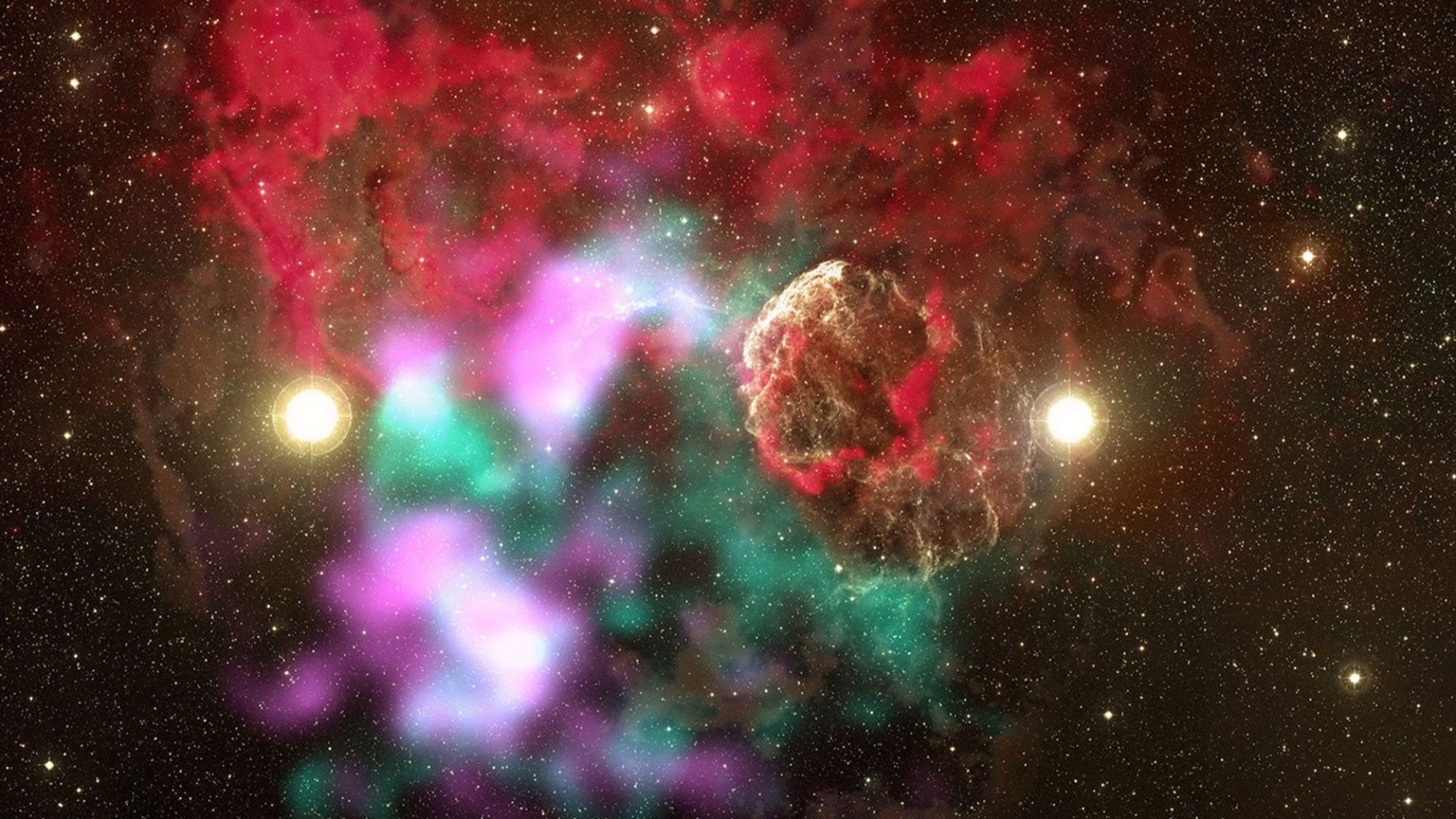
In a milestone for observational astrophysics, an international team of researchers has discovered the first confirmed binary star system in which both stellar companions exploded as catastrophic supernovae. Often compared to the fictional twin suns of Tatooine in Star Wars, this real-world cosmic pair once orbited each other in close proximity before both massive stars detonated in violent core-collapse explosions, leaving behind expanding shells of superheated gas and high-energy cosmic rays.
2.Research Team and Observational Challenges
The study, published in Nature Communications, was spearheaded by astrophysicist Dr. Miltiades Michailidis and his research group at Stanford University in California. Although massive O-type and B-type stars predominantly form in multi-star binary systems, catching both stars in their post-supernova remnant phase had never been achieved before. Detecting these systems is notoriously difficult for two main reasons: if the stars are situated too close together, their separate explosions merge into what appears as a single blast wave; conversely, if the first star's asymmetric explosion kicks the binary companion with sufficient force, the surviving star is hurled across interstellar space as a runaway star long before its own supernova occurs.
3.The Jellyfish Nebula (IC 443) and Companion G189.6+3.3
To locate the twin remnants, researchers focused their investigations on the iconic Jellyfish Nebula—designated in astronomical catalogs as IC 443—located approximately 6,000 light-years from Earth within the constellation Gemini. Named for its tendril-like filaments that resemble a floating jellyfish, IC 443 has long been studied as a textbook supernova remnant. However, close multi-wavelength scrutiny revealed that a fainter, previously cataloged remnant known as G189.6+3.3 overlaps directly along the northern periphery of IC 443.
4.16 Years of Multi-Wavelength Space Telescope Data
Confirmation of the shared binary origin required analyzing 16 consecutive years of high-energy gamma-ray data from NASA's Fermi Gamma-ray Space Telescope, combined with deep archival observations from the Chandra X-ray Observatory, optical surveys, and ground-based radio interferometers. The spatial and velocity maps proved conclusively that shockwaves from both IC 443 and G189.6+3.3 are colliding with the very same dense molecular hydrogen cloud. Astrophysical statistical models demonstrate that the probability of two independent, unrelated supernova progenitors overlapping at this exact celestial coordinate by sheer coincidence is less than 0.1% (one in a thousand).
5.Timeline, Mass Transfer, and Physics of the Explosions
Orbital and thermodynamic modeling reveals a dramatic evolutionary timeline for the twin stars. The primary star, having a mass roughly 20 to 25 times greater than our Sun, consumed its nuclear fuel first and exploded as G189.6+3.3 between 20,000 and 110,000 years ago. During its red supergiant phase, massive amounts of hydrogen envelope gas were gravitationally transferred to its secondary companion. The secondary star, rejuvenated by this accretion, evolved rapidly before detonating as IC 443 much more recently—approximately 8,000 to 9,000 years ago. Both detonations left behind compact neutron star cores, providing critical empirical benchmarks for theoretical models of binary mass transfer, gravitational wave progenitor formation, and stellar nucleosynthesis.
6.Implications for Binary Star Evolution and Gravitational Wave Progenitors
This historic finding resolves longstanding questions regarding binary star survival following supernova kicks. It provides direct evidence that massive binary pairs can remain gravitationally associated or co-located in shared natal nebulae even after the first catastrophic blast. Understanding the survival rates and remnant dynamics of such twin-explosion systems is crucial for calculating the formation rates of binary neutron stars and black hole mergers—the primary sources of gravitational wave events detected by LIGO and Virgo.
Frequently Asked Questions (FAQ)
Q1: What makes this double supernova discovery historically unique?
While massive stars frequently form in binary pairs, this is the first time astronomers have verified a system where both companion stars reached the end of their lives and exploded as separate core-collapse supernovae while remaining gravitationally bound to the same interstellar cloud.
Q2: Which supernova remnants comprise the twin system?
The system consists of the well-known Jellyfish Nebula (IC 443), which exploded approximately 8,000 to 9,000 years ago, and its dimmer companion remnant G189.6+3.3, which exploded between 20,000 and 110,000 years ago.
Q3: How did astronomers prove both remnants originated from the same binary pair?
By analyzing 16 years of Fermi Gamma-ray Space Telescope observations alongside radio and X-ray data, researchers proved that both remnants are actively interacting with the exact same molecular hydrogen cloud. The statistical probability of two unrelated supernovae occurring in such close spatial proximity by chance is less than 1 in 1,000.
Editorial Standards & Fact-Checking Transparency
This report adheres to Daily Science News' rigorous academic guidelines. All claims are verified against primary scientific literature from institutions including NASA, ESA, CERN, and peer-reviewed journals. Supervised by Dulaksha Sandeepa. Questions or corrections? Contact contact@sciencenewshub.click.