First-Ever Black Hole Star Discovered by James Webb Space Telescope
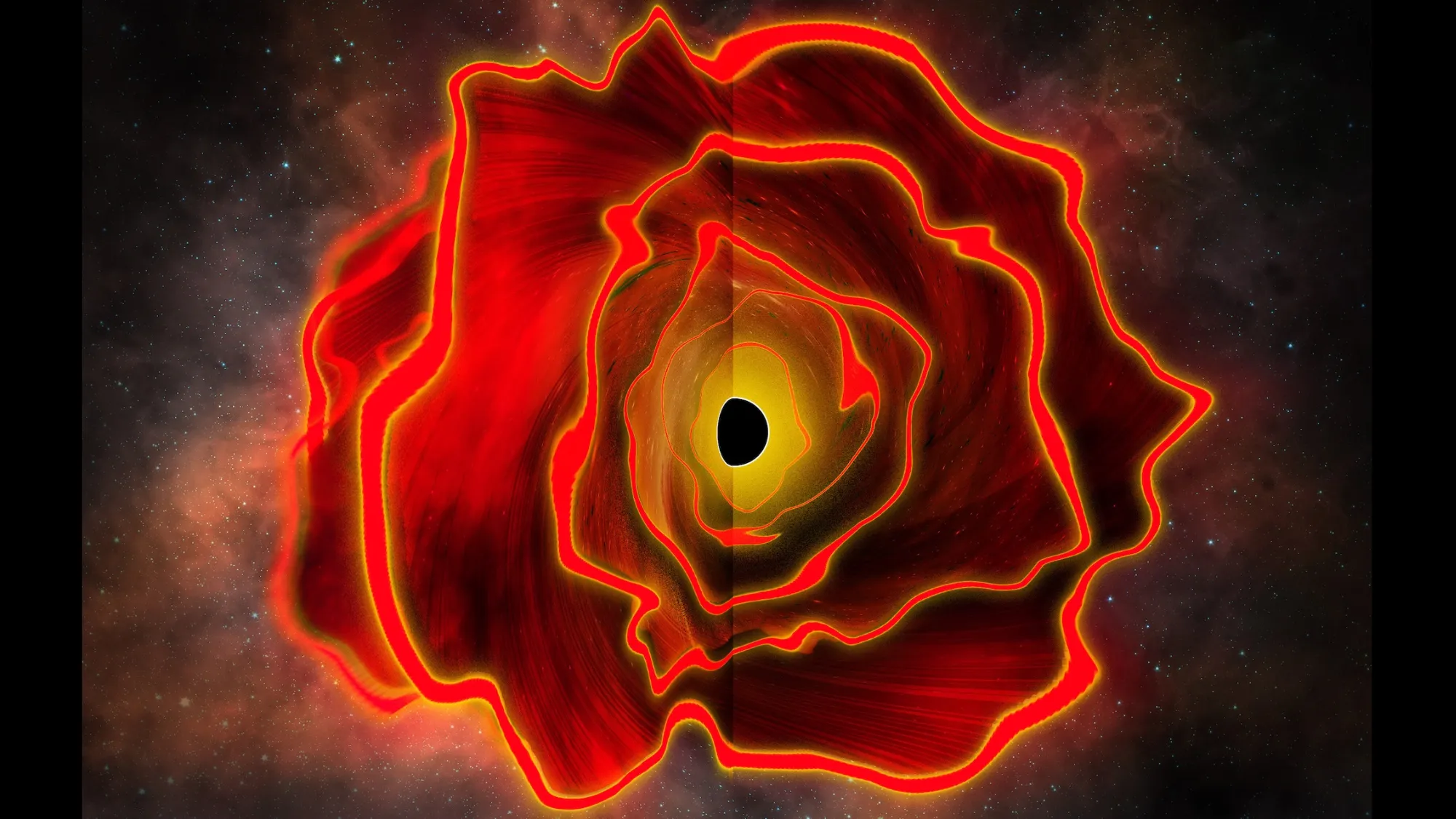
An international team of astronomers using NASA's James Webb Space Telescope has discovered a brand-new class of cosmic object — a black hole star — located billions of light-years away in the constellation Cetus, radiating 100 billion times more energy than any known star.
1.A Completely New Class of Cosmic Object
An international team of astronomers studying early-universe images captured by NASA's James Webb Space Telescope (JWST) has discovered a brand-new class of cosmic object, dubbed a black hole star. The object is comparable in size to our entire solar system and appears as an extremely bright red source in deep-space imagery. This discovery marks a groundbreaking moment in modern astrophysics, offering a glimpse into phenomena that have never been observed before in the history of astronomy.
2.Location and Origin: 660 Million Years After the Big Bang
The extraordinary object is located billions of light-years from Earth in the constellation Cetus (the Whale), and is believed to have formed around 660 million years after the Big Bang. Although it looks like an enormous star from the outside, it radiates roughly 100 billion times more energy than any star known to date — an energy output far closer to what is expected from a black hole than from an ordinary star. This staggering energy output immediately set it apart from anything scientists had catalogued before.
3.Dr. Rohan Naidu and the MIT Kavli Institute
Dr. Rohan Naidu, who led the research on behalf of MIT's Kavli Institute for Astrophysics and Space Research and now works at the University of Hawaii, says the object represents an entirely new category of cosmic body: it glows with the energy signature of a black hole while also displaying the characteristics of an ordinary star. This dual nature is precisely what has made MoM-BH*-1 so significant — it does not fit neatly into any pre-existing category of astronomical classification.
4.Computer Modeling Confirms the Find: Object MoM-BH-1
The team's attention was drawn to this extremely red object — officially catalogued as MoM-BH*-1 — after Webb data revealed one of the most distant galaxies ever found. Computer modeling confirmed that the object is not a giant star powered by nuclear fusion, but rather a massive black hole thickly shrouded in dense gas clouds, radiating like a star. These computational models were critical in ruling out conventional stellar explanations and establishing the object's unique nature.
5.Rethinking the Little Red Dots in Deep Space
This discovery suggests that many of the small, mysterious red dots frequently seen in deep-space images could likewise be black hole stars. For years, these faint reddish objects puzzled astronomers who could not definitively classify them. The identification of MoM-BH*-1 now provides a plausible explanation: these dots may represent the earliest stages of supermassive black hole formation, cloaked in gas and mimicking stellar behavior.
6.Implications for Galaxy Evolution and the Universe History
Dr. Naidu notes that such objects may play a crucial role in galaxy evolution, potentially representing the earliest stage of the supermassive black holes found at the centers of galaxies like our own Milky Way — objects capable of regulating star formation and shaping planet formation, the emergence of life, and the history of the universe itself. Understanding black hole stars could rewrite textbooks on how galaxies form and grow across cosmic time. The findings were published in the prestigious journal Nature.
Editorial Standards & Fact-Checking Transparency
This report adheres to Daily Science News' rigorous academic guidelines. All claims are verified against primary scientific literature from institutions including NASA, ESA, CERN, and peer-reviewed journals. Supervised by Dulaksha Sandeepa. Questions or corrections? Contact contact@sciencenewshub.click.