World's Most Powerful Solar Telescope Releases Clearest-Ever Images of the Sun's Surface
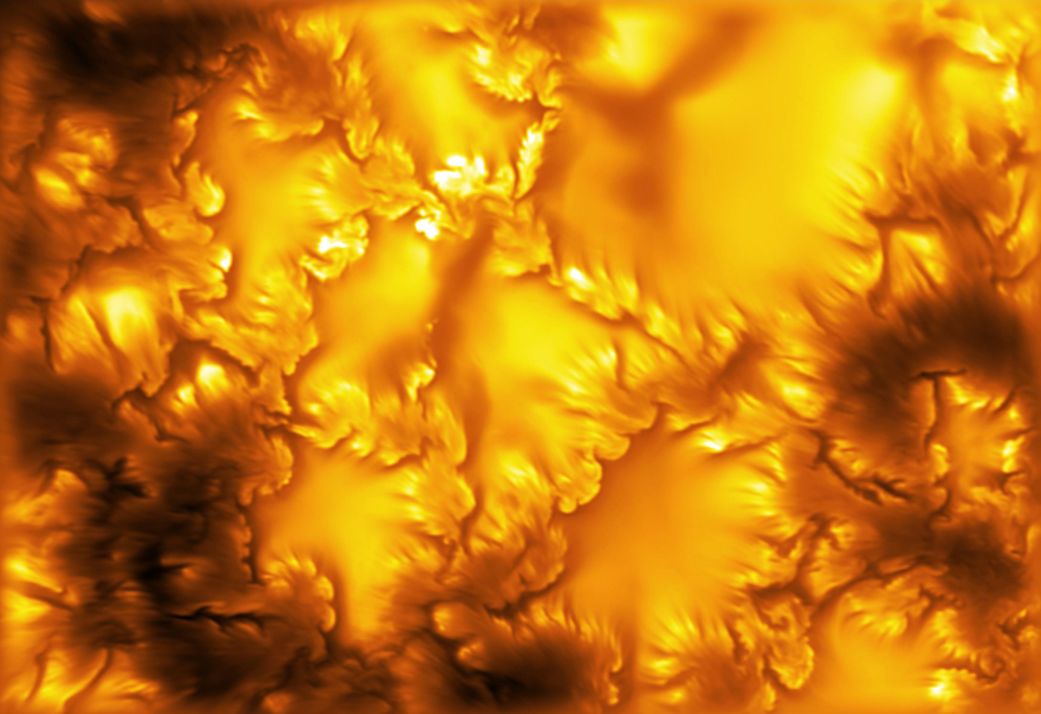
The Daniel K. Inouye Solar Telescope in Hawaii has released the highest-resolution images ever obtained of the Sun's photosphere, capturing for the first time tiny Kelvin-Helmholtz instabilities just 20 km wide — potentially solving the century-old mystery of why the Sun's corona is millions of degrees hotter than its surface.
1.Humanity's Sharpest View of the Sun Ever
The Daniel K. Inouye Solar Telescope — the world's most powerful solar telescope located on the summit of Haleakalā volcano in Maui, Hawaii — has released a series of the highest-resolution images ever obtained of the Sun's photosphere. These extraordinary photographs have, for the first time in history, captured extremely tiny wave-like turbulent patterns on the Sun's surface in stunning clarity. This is considered a remarkable milestone in the field of solar astronomy and astrophysics. Information related to this research was published in the prestigious journal Nature.
2.Kelvin-Helmholtz Instabilities: The Tiny Structures Revealed
These small vortex-like structures — which scientists call Kelvin-Helmholtz instabilities — have been observed at sizes as small as 20 kilometers across, an astonishing resolution that pushes the boundaries of what telescopes can achieve. These wave or vortex-like disturbances occur when two adjacent layers of plasma moving at different speeds slide past each other, creating turbulent wave patterns at their interface. The physics behind these structures is the same as the rippling pattern seen when wind blows across a water surface or when two different-speed air masses interact to form clouds.
3.Seen Everywhere in Nature — But Never on a Star
Although Kelvin-Helmholtz instabilities can be observed in Earth's oceans and lakes as surface waves, in the atmosphere between cloud layers, and even on the surfaces of gas giant planets like Jupiter and Saturn where they create the characteristic banded cloud structures, this is the first time this phenomenon has ever been directly observed on the surface of a star. This breakthrough observation required the extraordinary resolving power of the Inouye telescope — which has a 4-meter primary mirror, making it by far the largest solar telescope ever built.
4.Solving the Corona's Million-Degree Mystery
As research team leader Dr. David Kuridze of the National Solar Observatory and his team points out, this new discovery paves the way for solving one of astronomy's greatest mysteries of recent decades — namely, how the Sun's outer atmosphere (the corona) reaches temperatures of millions of degrees Celsius when the solar surface temperature is only about 6,000 degrees Celsius. This temperature reversal — called the coronal heating problem — has puzzled solar physicists for over 80 years, ever since the corona's extreme temperature was first measured. The discovery of these turbulent instabilities provides a compelling physical mechanism for the energy transfer.
5.How Turbulence Heats the Corona
The research team believes that the magnetic energy generated by these continuous turbulences and plasma vortices gradually travels upward through the solar atmosphere and is released as enormous heat in the corona. As these Kelvin-Helmholtz instabilities churn and twist the Sun's magnetic field lines, they generate Alfvén waves — electromagnetic waves that propagate along magnetic field lines. These waves carry energy upward and eventually deposit it into the corona, explaining how a relatively cool 6,000°C surface can maintain an atmosphere that reaches 1-3 million degrees Celsius.
6.Solar Flares and Coronal Mass Ejections Explained
Additionally, this discovery also provides new insight into how magnetic energy builds up to cause massive solar explosions such as solar flares and coronal mass ejections (CMEs). When plasma vortices twist and stress magnetic field lines beyond a critical point, the stored magnetic energy is explosively released in these powerful events. Understanding the triggering mechanisms of solar flares and CMEs is crucial for improving space weather prediction — since these violent eruptions can disrupt Earth's magnetic field, knock out power grids, interfere with GPS navigation, and damage satellites in orbit.
7.Critical for Protecting Earth's Technology
These latest high-resolution solar observations from the Inouye telescope are extremely important for the early detection of space weather conditions that could seriously affect Earth's power grid systems, satellite communications, aviation radio communications, and GPS technology. A sufficiently powerful solar storm — known as a Carrington-class event — could potentially cause trillions of dollars in damage to modern infrastructure that has become deeply dependent on space-based technology and uninterrupted electricity grids. The ability to predict such events days in advance could allow utilities, airlines, and satellite operators to take protective measures and minimize potential catastrophic damage to our technological civilization.
Editorial Standards & Fact-Checking Transparency
This report adheres to Daily Science News' rigorous academic guidelines. All claims are verified against primary scientific literature from institutions including NASA, ESA, CERN, and peer-reviewed journals. Supervised by Dulaksha Sandeepa. Questions or corrections? Contact contact@sciencenewshub.click.