Psyche Spacecraft Uses Mars Gravity Assist to Gain Speed
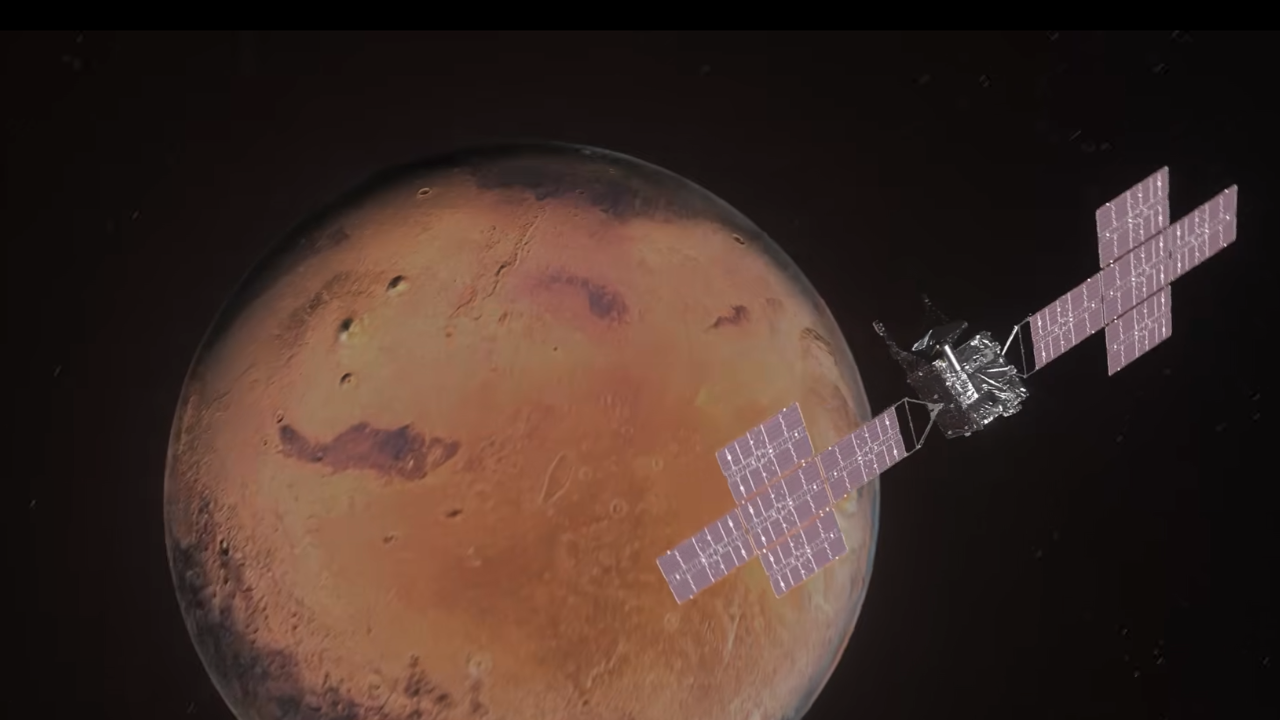
NASA's Psyche spacecraft successfully passed by Mars on May 15, 2026, using the planet's gravity to gain crucial speed and alter its trajectory. This gravity assist maneuver will help the spacecraft reach the metallic asteroid 16 Psyche in July 2029.
1.Historic Mars Flyby: A Critical Milestone
NASA's Psyche spacecraft, launched to explore the metallic asteroid 16 Psyche, successfully passed by Mars on Friday, May 15, 2026, crossing a critical milestone in its mission. The spacecraft flew as close as 4,500 kilometers from the Martian surface, traveling at a speed of 19,848 kilometers per hour. However, this remarkable flyby was not planned for the purpose of studying Mars — rather, it was carried out to use Mars' gravity as a boost to increase the spacecraft's speed and alter its trajectory in what is known as a gravity assist.
2.The Art of Gravity Assist: Interplanetary Billiards
Space scientists describe the gravity assist technique as a kind of 'interplanetary billiards.' The spacecraft is caught by Mars' gravitational pull and uses it to gain speed. The spacecraft effectively borrows a tiny fraction of the energy Mars uses to orbit the Sun, increasing its velocity by approximately 2 kilometers per second. This elegant technique allows spacecraft to reach distant destinations that would otherwise require enormous amounts of fuel.
3.The Fuel Problem: Why Gravity Assist Is Critical
Sources note that attempting to achieve the same change in speed and trajectory using only the spacecraft's engines and fuel would have required an amount of fuel too large to carry, at an enormous cost. This would make the mission economically unfeasible and technically impossible with current spacecraft design. The gravity assist maneuver is therefore absolutely critical to the mission's success, enabling the Psyche spacecraft to reach its distant target without prohibitive fuel consumption. This technique demonstrates how understanding celestial mechanics can overcome the limitations of onboard fuel supplies.
4.The Target: A Unique Metallic Asteroid
The Psyche spacecraft's final destination is the unique metallic asteroid known as 16 Psyche, located between Mars and Jupiter. Approximately 280 kilometers wide, scientists suspect this asteroid may be the metallic core of a planet that was destroyed long ago. This extraordinary hypothesis makes 16 Psyche one of the most scientifically intriguing targets in the solar system. Unlike typical rocky asteroids composed primarily of silicate minerals, 16 Psyche appears to be composed largely of iron and nickel—materials that typically form the interior cores of planets.
5.Scientific Significance: Understanding Planetary Formation
Scientists believe that studying this asteroid will provide humanity with direct observations—unlike any obtained before—into how the interiors of rocky planets like Earth were formed. By examining 16 Psyche, researchers can gather invaluable data about planetary core composition, structure, and formation processes. This knowledge will enhance our understanding of how planets like Earth developed and will provide insights into the early solar system. The metallic nature of 16 Psyche offers a rare opportunity to directly study planetary building blocks that are normally hidden deep within planetary interiors.
6.Historical Precedent: Proven Gravity Assist Missions
In the past, the gravity assist technique was successfully used in renowned missions such as Voyager, Cassini, and New Horizons. The Voyager missions employed multiple gravity assists to gain the velocities necessary to escape the solar system and continue transmitting data decades after their launches. The Cassini spacecraft used gravity assists to reach Saturn and its moon Titan. NASA's New Horizons probe employed multiple gravity assists to reach Pluto and the Kuiper Belt. These successful heritage missions demonstrate the reliability and effectiveness of gravity assist maneuvers when executed with precision.
7.Mission Timeline: On Course for July 2029 Arrival
Having used Mars' assistance to set itself on the correct path, the Psyche spacecraft is now scheduled to reach its target asteroid in July 2029. This represents approximately three years of transit time following the Mars gravity assist. During this journey, the spacecraft will continue its scientific observations and data transmission to Earth, allowing mission scientists to monitor spacecraft systems and prepare instruments for the asteroid encounter. The arrival date marks the culmination of years of planning, engineering, and mission execution, promising groundbreaking scientific discoveries about the nature of planetary formation.
8.The Psyche Mission: Unlocking Planetary Mysteries
The Psyche mission represents an ambitious endeavor to answer fundamental questions about planetary science and solar system formation. By sending a spacecraft to a unique metallic asteroid, NASA is opening new frontiers in our understanding of how planets are built and what lies at their cores. The successful Mars gravity assist demonstrates the mission's progress toward achieving its scientific objectives. With advanced instrumentation aboard the Psyche spacecraft, scientists will conduct detailed observations of the asteroid's composition, magnetic properties, and geological features, revolutionizing our knowledge of planetary interiors.
9.Engineering Excellence: A Mission of Precision
The execution of the Mars gravity assist required extraordinary precision in trajectory calculation, timing, and navigation. Mission engineers at NASA had to account for the gravitational fields of both the Sun and Mars, the spacecraft's velocity and mass, and the desired outcome trajectory to reach 16 Psyche. The successful flyby at exactly 4,500 kilometers distance at the calculated velocity demonstrates the exceptional capabilities of modern space engineering and mission planning. This precision achievement reflects decades of experience in deep space navigation and the sophisticated computer modeling and real-time adjustments that guide interplanetary spacecraft.
10.Looking Forward: The Future of Asteroid Science
The Psyche mission marks a significant step forward in humanity's exploration of the solar system and our quest to understand planetary science. Following the successful Mars gravity assist, the mission is on track to revolutionize our knowledge of asteroid composition and planetary formation. As the Psyche spacecraft continues its journey toward 16 Psyche, it carries humanity's hope of unlocking the secrets held within what may be a remnant planetary core. The scientific discoveries awaiting the mission's arrival at this remarkable asteroid will shape our understanding of planetary science for generations to come.
Editorial Standards & Fact-Checking Transparency
This report adheres to Daily Science News' rigorous academic guidelines. All claims are verified against primary scientific literature from institutions including NASA, ESA, CERN, and peer-reviewed journals. Supervised by Dulaksha Sandeepa. Questions or corrections? Contact contact@sciencenewshub.click.