SpaceX Falcon 9 Upper Stage Crashes Into the Moon — Creating a 27-Meter Crater
A SpaceX Falcon 9 rocket upper stage, launched in January 2025 and abandoned in a high Earth orbit after its fuel ran out, crashed into the lunar surface on August 5, 2026, creating a crater approximately 27 meters wide — providing scientists with valuable data about space debris risks to future Moon missions.
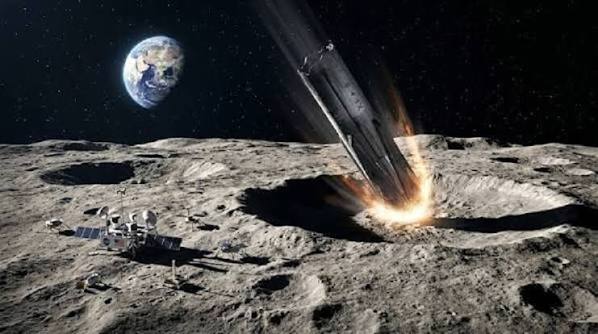
1.SpaceX Rocket Piece Impacts the Moon
An upper stage component of a SpaceX Falcon 9 rocket crashed into the lunar surface on August 5, 2026. The impact occurred at approximately 12:05 PM Sri Lanka time (0635 GMT) and is expected to have created a crater approximately 27 meters wide on the Moon's surface. The event was predicted by orbital mechanics specialists weeks in advance, giving scientists time to prepare for observations and data collection from this unplanned but scientifically valuable natural experiment.
2.The Journey: From Earth to Moon Over 18 Months
This Falcon 9 rocket was originally launched in January 2025. Its mission was to send Firefly Aerospace's 'Blue Ghost' and Japan's ispace company's 'Resilience' private lunar landers toward the Moon. While the first stage of a Falcon 9 rocket can normally be returned to Earth and reused — one of SpaceX's signature achievements — the upper stage is used only once. In this particular mission, releasing the two lunar landers into a very distant trans-lunar orbit had nearly completely depleted the rocket's fuel reserves, leaving it unable to perform the deorbit burn needed to return to Earth's atmosphere.
3.Why Did It Head Toward the Moon?
After drifting around Earth for approximately 18 months in a chaotic, highly elliptical orbit, how this 4,000-kilogram rocket component began heading toward the Moon puzzled many observers. SpaceX spokesperson Juliana Scheiman explained that a combination of solar radiation pressure and gravitational influences in the orbital region naturally altered the rocket's trajectory over time, gradually reshaping its orbit until lunar gravity captured the object and drew it inevitably toward a lunar impact. This natural orbital evolution was carefully tracked by debris monitoring organizations worldwide.
4.Why Couldn't Scientists Watch Live?
Since this impact occurred on the sunlit side of the Moon facing away from Earth at the moment of impact, most observers on Earth were unable to directly witness the event in real time. However, lunar orbiters and spacecraft already positioned around the Moon, including NASA's Lunar Reconnaissance Orbiter, were positioned to detect and image the freshly formed impact crater in the days and weeks following the collision. These observations will provide detailed data about the crater's size, shape, and ejecta pattern.
5.Scientific Value: Studying Space Debris Risks
Despite being an unintended crash, the event provides scientists with an excellent and rare opportunity to study the potential risks that space debris poses to NASA's upcoming Artemis Moon-landing missions, future permanent lunar outposts, and eventually human astronauts on the lunar surface. By analyzing the resulting crater's characteristics and comparing them to predictions from impact physics models, engineers can better understand the damage potential of space debris impacts — crucial data for designing protective structures for future lunar habitats and equipment.
6.Historical Precedents: Rockets That Hit the Moon Before
This is not the first time rocket components have crashed into the Moon. Previously, several sections of Saturn V rockets from NASA's legendary Apollo missions impacted the Moon — deliberately, as a way to create seismic waves that could be detected by instruments placed by Apollo astronauts to study the Moon's internal structure. More recently, an upper stage of China's Long March 3C rocket, launched in 2014, crashed into the Moon in March 2022, creating an unusual double crater that intrigued planetary scientists. As more commercial lunar missions are launched, debris management around the Moon is becoming an increasingly important topic for international space policy discussions.
Editorial Standards & Fact-Checking Transparency
This report adheres to Daily Science News' rigorous academic guidelines. All claims are verified against primary scientific literature from institutions including NASA, ESA, CERN, and peer-reviewed journals. Supervised by Dulaksha Sandeepa. Questions or corrections? Contact contact@sciencenewshub.click.