A Wasp Named in Honor of David Attenborough on His 100th Birthday
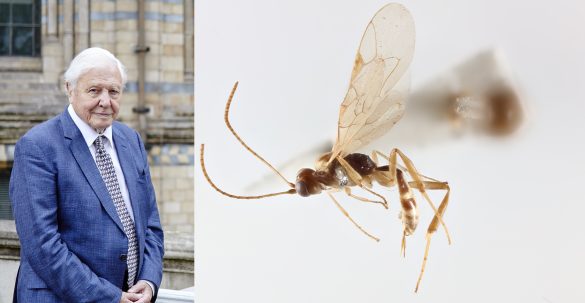
Scientists at the Natural History Museum in London have named a newly discovered genus of parasitic wasps after the world-renowned naturalist and broadcaster Sir David Attenborough on his 100th birthday.
1.A Historic Honor
Scientists at the Natural History Museum in London have taken steps to name a newly discovered genus of parasitic wasps after the world-renowned naturalist and broadcaster Sir David Attenborough, as a tribute on the occasion of his 100th birthday. This special honor has been bestowed in celebration of his birthday, which falls on May 8th. The gesture represents a remarkable recognition of Attenborough's profound impact on science communication and environmental awareness worldwide.
2.Meet Attenboroughnculus tau
Scientifically named Attenboroughnculus tau, this newly discovered wasp species is an extremely tiny creature, measuring just about 3.5 millimeters in body length. The species name 'tau' was added due to a marking on its abdomen that resembles the letter 'T.' Despite its diminutive size, this species represents an entirely new genus, highlighting the biodiversity still waiting to be catalogued in museum collections.
3.A Long Journey to Discovery
Looking at the history of this insect, it was first collected in 1983 from the Valdivia region of Chile. The specimen had been sitting unnoticed in a drawer at the Natural History Museum in London for over four decades, until it was recently brought to the attention of a volunteer named Agostijn De Ketelaere. This rediscovery demonstrates the value of careful curation and the importance of revisiting existing collections with fresh eyes.
4.A Lifetime Inspiration
Dr. Gavin Broad, Principal Curator of Insects at the museum who led the study, says that as a child he was inspired to become a taxonomist after watching David Attenborough's Life on Earth television series. The discovery of this new species and its naming represent a full-circle moment, with a scientist whose career was shaped by Attenborough's work now honoring him through the formal recognition of a new species.
5.A Distinct New Genus
Since this new creature displayed characteristics significantly different from its closest relatives, it could not be placed in any existing genus, and was therefore decided to be named as an entirely new genus. This distinction underscores the unique nature of the discovery and the importance of careful taxonomic classification in understanding Earth's biodiversity.
6.The Mystery of Parasitic Wasps
While these parasitic wasps are known to lay their eggs inside the bodies of other animals, further details about their life cycle have yet to be uncovered. Scientists remain intrigued by the behavioral and ecological adaptations of these tiny insects, which may yield important insights into parasitoid biology and host-parasite relationships.
7.A First for Attenborough
Although many animals — including bats, spiders, and lizards — have previously been named after Attenborough, this marks the first time an entire animal genus has been named in his honor. This distinction reflects the unprecedented impact of his work and his continued relevance to the scientific community as an inspiration for multiple generations of researchers.
8.Unlocking Hidden Biodiversity
Scientists hope that discoveries like this will draw the attention of researchers around the world to other unknown species that may be hidden within historic museum collections. The finding serves as a reminder that scientific progress depends not only on new expeditions but also on careful examination of specimens preserved over decades, which may hold untold secrets about Earth's magnificent biodiversity.
Editorial Standards & Fact-Checking Transparency
This report adheres to Daily Science News' rigorous academic guidelines. All claims are verified against primary scientific literature from institutions including NASA, ESA, CERN, and peer-reviewed journals. Supervised by Dulaksha Sandeepa. Questions or corrections? Contact contact@sciencenewshub.click.